Year 9 Science · Lesson 9

Natural selection in action

Games, simulations and real data

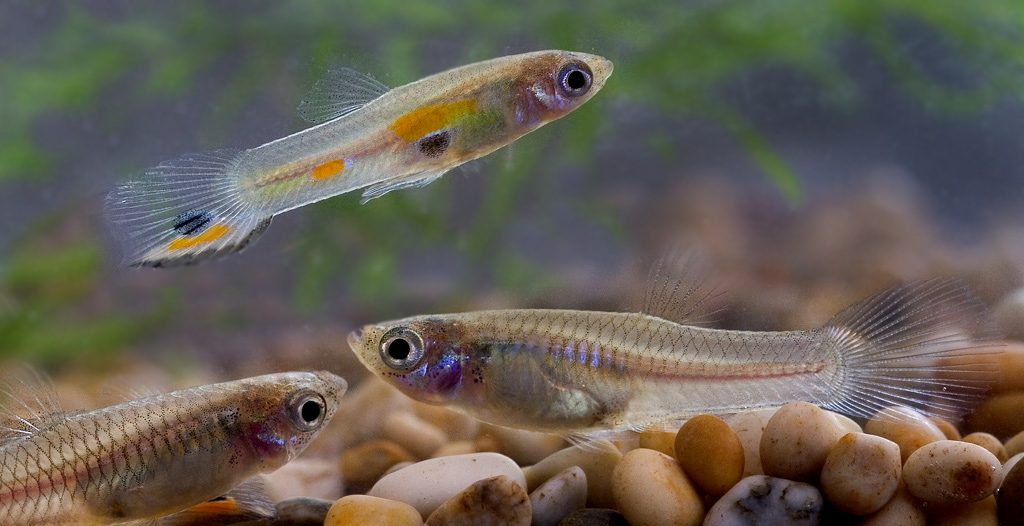
A colourful male guppy swimming above two plain females
Wild-type guppies: one spotted male, two plain females. Per Harald Olsen, CC BY 3.0

Quick recall

Natural selection: the five steps

Write them down from memory, in order, before the next click.

1
Variation
2
Selection
3
Reproduction
4
Inheritance
5
Time

Lab manual p19

Bear Island: the jelly bear evolution game

  • Jelly bears of four colours live on a patterned "island".
  • Predators have a few seconds to grab the bears they can see.
  • Every surviving bear reproduces: add one more bear of its colour.
  • Count each colour and record it. Repeat for five generations.

Your teacher may change the rules. Whatever they are, record every generation in the table on p19.

Lab manual p19 Q2

Which colour survived best?

Explain why, using the idea of natural selection.

Simulation · Lab manual p19 Q3

PhET: Natural Selection

phet.colorado.edu: Natural Selection

  1. Add a mutation, such as brown fur or long teeth.
  2. Add a selection factor: wolves, or limited food.
  3. Run several generations and watch the population graph.

Which trait became more common over several generations, and why?

Real science

Guppies in Trinidad

Male guppies have bright, colourful spots. Females prefer to mate with the most colourful males.

But in some streams live pike cichlids, fish that hunt guppies. Bright spots are easy for them to see.

Above some waterfalls the big predators can't reach. The guppies there are much safer.

In the 1970s and 80s, biologist John Endler studied these streams. The data on the next slides are an example based on his work.

A colourful male guppy swimming above two plain females
Per Harald Olsen, CC BY 3.0

Read the data

Spots on male guppies in a stream with predators

0 5 10 15 0–2 3–5 6–8 9–11 12+ Number of spots per male Number of males
  1. Which number of spots is most common? 3–5 spots, 14 males.
  2. Which is least common? 12 or more: no males at all.
  3. Why might males with lots of spots be rare here? Predators see them more easily, so fewer survive to breed.

Example data based on Endler's guppy studies.

Predict

Some of these guppies are moved above a waterfall, where there are no big predators

Predict how the number of spots on the males will change over many generations.

Explain your prediction using the five steps: variation, selection, reproduction, inheritance, time.

Many generations later

Compare the two streams

0 5 10 15 0–2 3–5 6–8 9–11 12+ Number of spots per male Number of males With predators Without predators

The most common group moved from 3–5 spots (14 males) to 6–8 spots (10 males).

Males with 12 or more spots went from 0 to 4.

Without predators, bright males survive. Females choose them, so they have more offspring, which inherit the genes for more spots.

Example data based on Endler's guppy studies.

Generalise · Lab manual p19

The big idea

Natural selection can determine which adaptations are the best at meeting the requirements for MRS C GREN.

With predators, plain colouring helped guppies survive. Without them, bright colouring helped them reproduce. The best adaptation depends on the environment.

Exit question · Lab manual p19

Rewrite the big idea in your own words

Then give an example from Bear Island, PhET or the guppies.
Start with: "The environment decides…"

Away today?

Missed this lesson? Catch up here