Year 9 Science · Lesson 14
Revision
Getting ready for the topic test
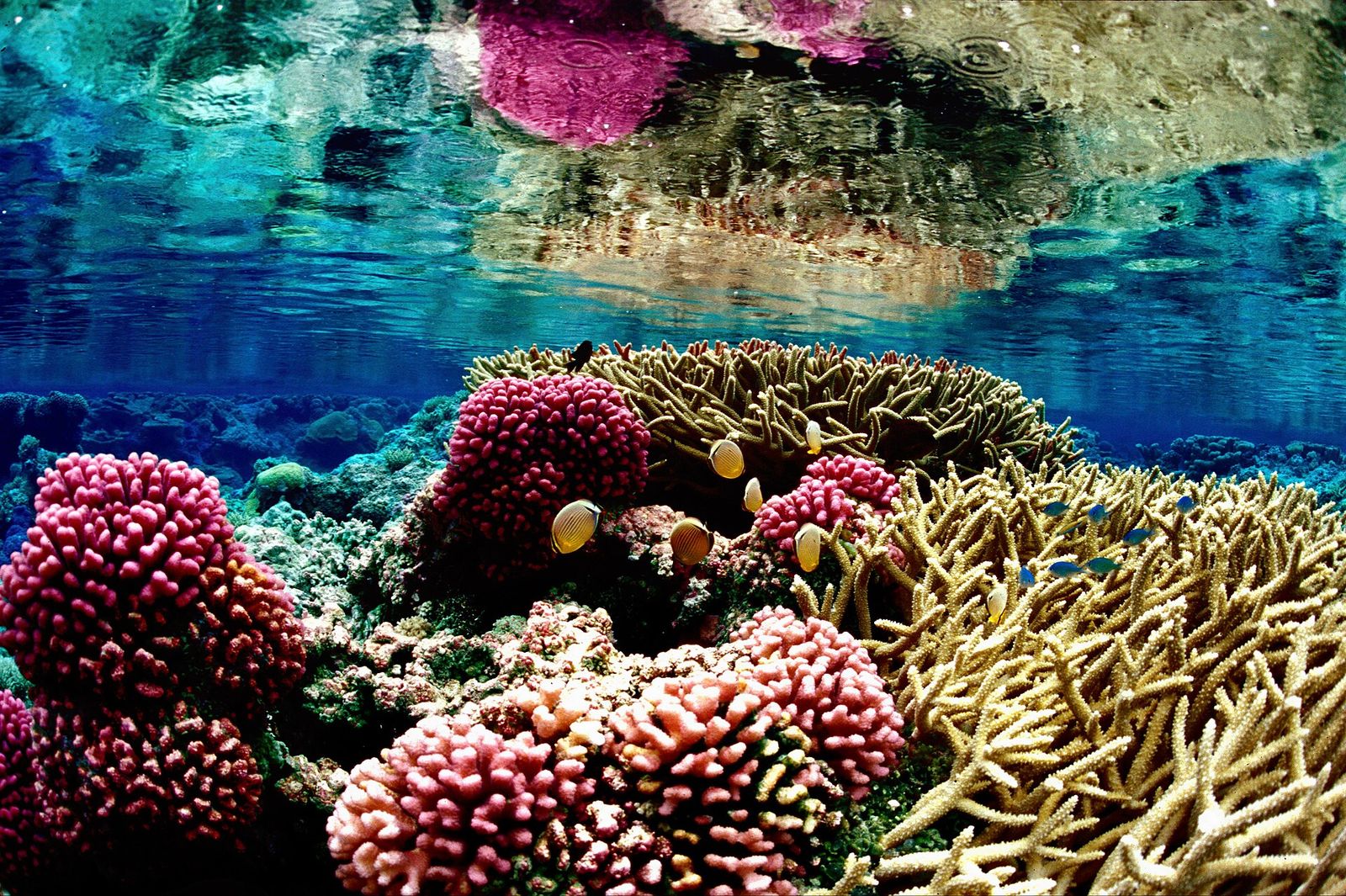
Coral reef, Palmyra Atoll. U.S. Fish and Wildlife Service, Pacific Region. CC BY 2.0

Lab manual p33
How the topic test works
Criterion A: Knowing and understanding. It covers the whole unit.
Each section starts easy and gets harder. Attempt every question: the hard ones are where the top levels are.
Lab manual p2 to p3
Check your progress
- Go back to the Know and Do checklist at the front of your lab manual.
- For every row, tick "I can do this!" or "I still need help…".
- Circle the two rows you are least sure about. Those are your revision for today and tonight.
Ask about anything you still need help with today. Not the night before the test.
Read the question
Command terms: what each one wants
| Term | What to do |
|---|---|
| State | Give a name, value or short answer. No explanation needed. |
| Outline | Give a brief account: the main points, in a sentence or two. |
| Describe | Give a detailed account of a process, step by step. |
| Suggest | Propose a possible answer, and give a reason for it. |
| Use the data | Quote specific values from the graph or table, with units. |
Quick-fire quiz · part 1
Write your answers, then check
- List the seven levels of classification. Kingdom, phylum, class, order, family, genus, species.
- Name the three domains of life. Archaea, Bacteria, Eukarya.
- Name the three types of adaptation. Structural, behavioural, physiological.
- What is variation? The differences between individuals of the same species.
- Why is a bat a mammal, not a bird? It has fur and feeds its young milk.
Quick-fire quiz · part 2
Write your answers, then check
- List the five steps of natural selection. Variation, selection, reproduction, inheritance, time.
- Why did dark peppered moths become common? On sooty trees, birds ate more light moths, so dark ones survived to breed.
- How many chromosomes are in a human gamete? 23.
- What is a zygote? A fertilised egg, with DNA from both parents.
- What is a mutation? A mistake made when DNA is copied.
Be the marker
"Describe how the number of spots can be passed from a male guppy to his offspring."
Rank them from weakest to strongest. Then: what would B need to add to become C?
How they'd be marked
From "states" to "describes"
- A just states a link. No science words: low level.
- B outlines the idea: genes, sperm, fertilisation. Correct, but brief: middle level.
- C describes the whole process in order: genes on chromosomes, gametes with one copy, fertilisation, zygote with two copies, inheritance. Top level.
To move up a level: use the key words, put the steps in order, and link them back to the trait in the question.
Practise with data
Beetles on a volcanic island
A volcano erupts and covers the island's pale sand in dark ash. Birds eat the beetles they can see. (Example data.)
Practise with data
Questions
- Which colour was most common before the eruption? Light, 85%.
- Describe how the population changed. Use the data. Dark beetles rose from 15% to 90%; light beetles fell from 85% to 10%.
- Explain the change using natural selection. Beetles varied in colour. On dark ash, birds saw and ate more light beetles (selection). More dark beetles survived to reproduce, and their offspring inherited dark colour. Over 20 generations (time), dark beetles became common.
- A student says, "The beetles turned dark because they needed to hide." Do you agree? No: the dark beetles were already there. The ash didn't change any beetle; it changed which ones survived.
Lab manual p33
Revise your weakest section
Cornell notes
- Left column: key questions or words.
- Right column: your notes.
- Bottom: a short summary in your own words.
Cover the right column and test yourself from the left.
Vocabulary
Practise with the class Quizlet flashcards:
quizlet.com/682753037/flashcards
And every lesson's slides are on the unit page.
Exit question
Your revision plan
The section I most need to revise is ______. Tonight I will ______.
Away today?
Missed this lesson? Catch up here
- Tick the Know and Do checklist (lab manual p2 to p3) and pick your two weakest rows.
- Do the quick-fire quiz on slides 5 and 6 without looking, then check.
- Rank the three guppy answers on slide 7, then read slide 8.
- Answer the beetle questions on slide 10 before you reveal the answers.
- Make Cornell notes on your weakest section, and practise on Quizlet.